PRESS RELEASE
HOLOBIONT a grouped group show
HOLOBIONT
A grouped group show 8 to 13 September 2026RWK Studios by 3CA, Robert-W.-Kempner-Straße 6-8, 14167 Berlin-Zehlendorf
Alongside Berlin Art Week 2026
Press release, key facts, programme, background texts, images and logos for editorial use:
https://drive.google.com/drive/folders/1-6hbPI7DViwB8tIB8hwDz8t0MnT4aGhd
Contact
Franziska Röhrs
contact@3caberlin.com
+49 178 6307887
www.3caberlin.com
IG @3caberlin
PRESS RELEASE
HOLOBIONT: seven exhibitions, sixty artist studios, one week at the RWK Studios
From 8 to 13 September 2026, 3CA brings together seven independently curated exhibitions across the RWK Studios in Berlin-Zehlendorf. Each exhibition stands on its own. Shared infrastructure, space and audience make them temporarily readable as a larger whole: a grouped group show.
Berlin, 14 August 2026. HOLOBIONT asks what happens when autonomous exhibitions begin to exist in relation to one another.
For one week, seven exhibitions unfold across the RWK Studios, a 16,000 square metre art and production site in Berlin-Zehlendorf where around sixty artists work. The exhibitions occupy halls and spaces across the site, while studios and working environments become part of the wider programme.
Each of the seven exhibitions has its own curatorial approach, artists and internal logic. Conceived independently, they come into relation through a shared site, infrastructure, audience and time. Together, they form what we call a grouped group show.
The exhibitions were selected through an open call framed by HOLOBIONT, with a jury comprising Jan Gustav Fiedler (curator), Billy Jacob (Director, Kollektion888), Pola van den Hövel (Director and Curator, Villa Schöningen), and Jennifer Braun (art historian, critic and writer, The Gen Z Art Critic).
During the jury process, thematic dialogue between the proposals was considered alongside the strength of each exhibition on its own. No subthemes were prescribed. Yet certain concerns repeatedly surfaced across independently developed concepts. The body as a site of projection, discipline and transformation; shifting boundaries between the organic and the synthetic, the human and the non-human; and questions of perception, constructed realities and estrangement. Further affinities in materials, surfaces and atmospheres became visible as the proposals were read alongside one another. These similarities were not part of the brief and were not something the jury had set out to find.
Whether these resonances reflect a shared response to the present, to technology, to Berlin or to a broader sense of instability remains an open question.
Alongside the open call, the exhibition NO STORIES, NO MIRRORS brings together artists based at RWK Studios, embedding the perspectives of those working within the site itself. Developed in direct relation to the building, the exhibition includes site-specific works and forms one of the seven exhibitions within HOLOBIONT.
A holobiont describes a host together with the organisms living in and on it. Separate organisms remain distinct, while their relationships create a larger ecological unit.
The concept is closely connected to the work of evolutionary biologist Lynn Margulis and her research into symbiosis. Even the cells of complex organisms carry the history of earlier biological mergers. Mitochondria descend from bacteria that entered into relationships with other cells and eventually became part of their internal structure. Symbiosis does not automatically mean harmony. Cooperation, dependence, competition and exploitation can coexist and shift with conditions.
HOLOBIONT transfers this model into the exhibition space.
The wider programme opens the RWK Studios as both an exhibition site and a place of ongoing artistic production. Alongside the seven exhibitions, visitors encounter open studios, curatorial tours, artist talks, performances and a closing Open House.
3CA provides the framework through shared space, technical infrastructure, workshops, networks, knowledge and collective labour. The production site remains visible throughout.
For one week, seven autonomous exhibitions become part of the same organism.
THE SEVEN EXHIBITIONS
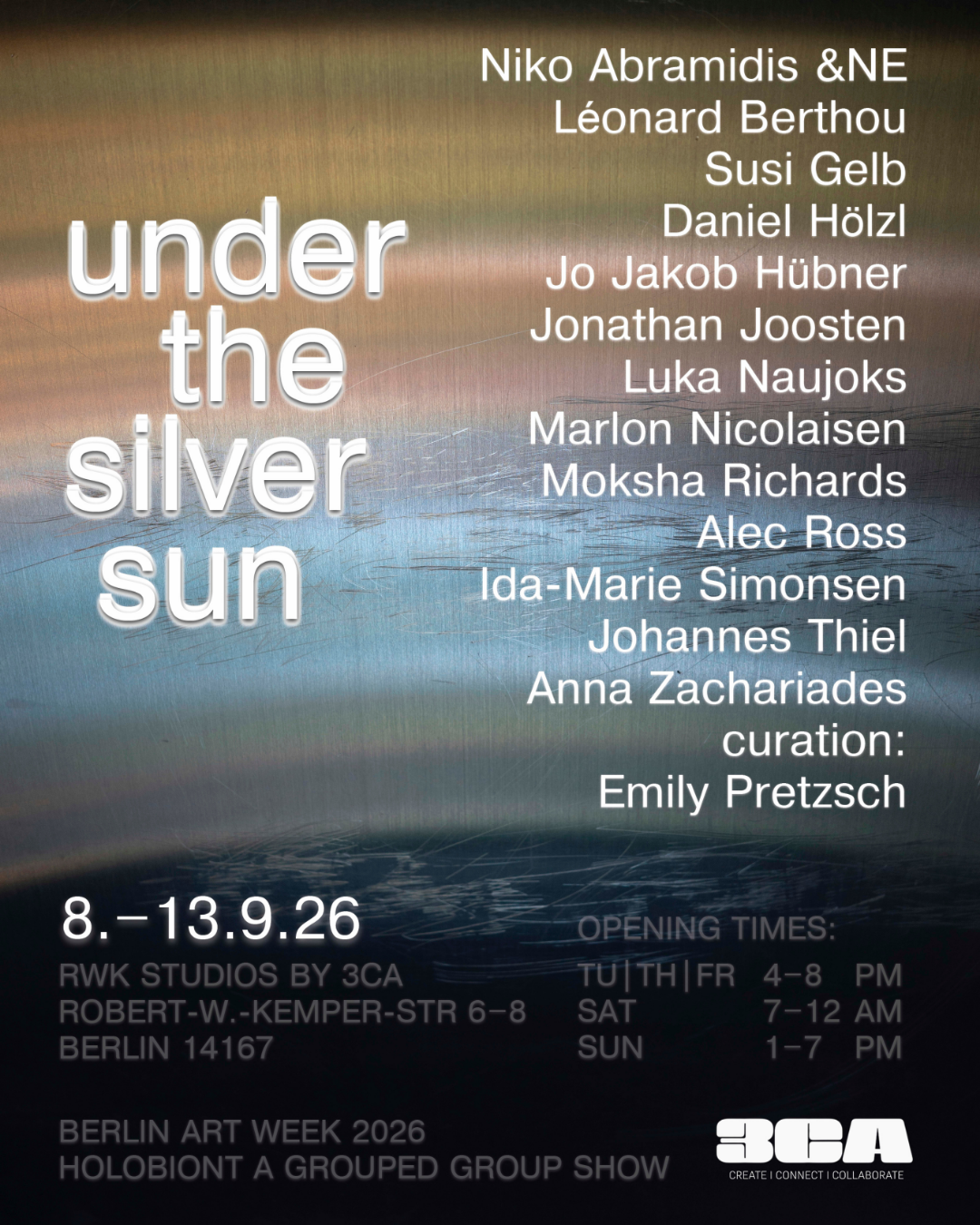
1. UNDER THE SILVER SUN
Hall 1, 200 m²
Curated by: Emily Pretzsch
Artists: Niko Abramidis &NE, Léonard Berthou, Susi Gelb, Daniel Hölzl, Jo Jakob Hübner, Jonathan Joosten, Luka Naujoks, Marlon Nicolaisen, Moksha Richards, Alec Ross, Ida-Marie Simonsen, Johannes Thiel, Anna Zachariades
UNDER THE SILVER SUN approaches the laboratory as both a material site and a cultural idea: a place of experimentation, repetition, failure and transformation. Across installation, sculpture, moving image, sound and performance, the exhibition assembles a posthuman archive in which the position of observer and observed becomes increasingly unstable.
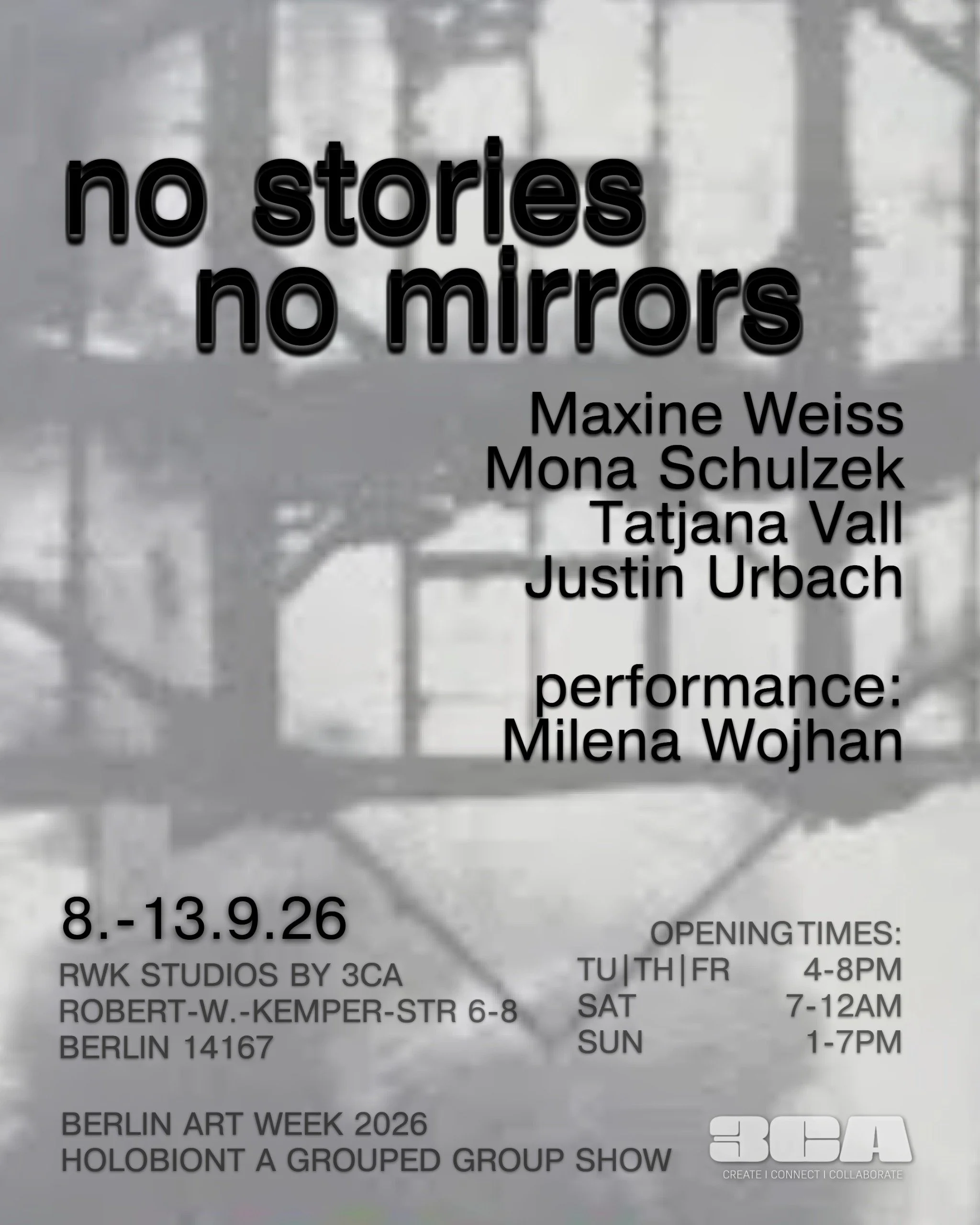
2. NO STORIES, NO MIRRORS
Hall 2, 800 m²
Self-organised by the participating artists
Artists: Mona Schulzek, Justin Urbach, Tatjana Vall, Maxine Weiss, Milena Wojhan
NO STORIES, NO MIRRORS creates a spatial constellation shaped by darkness, partial illumination and unstable perception. Sound, light, video, sculpture and performance emerge and disappear across the hall, producing fragments of possible worlds without resolving them into a single narrative.
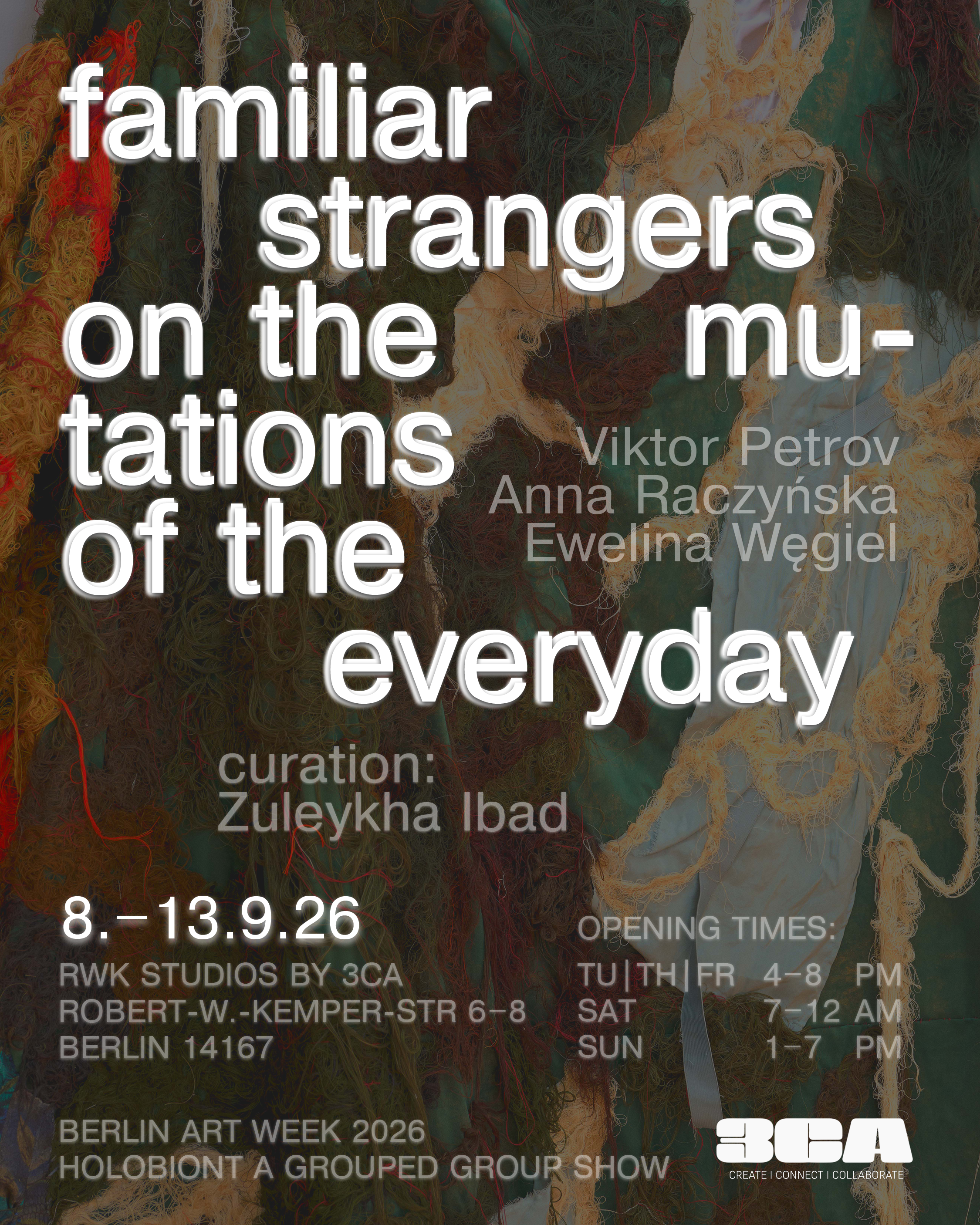
3. FAMILIAR STRANGERS
Hall 3, shared, 400 m²
Curated by: Zuleykha Ibad
Artists: Ewelina Węgiel, Anna Raczyńska, Viktor Petrov
Taking its title from Stanley Milgram's concept of the familiar stranger, FAMILIAR STRANGERS examines the point at which the known becomes unfamiliar. Drawing on experiences of migration across Central and Eastern Europe, the artists transform domestic objects, materials and everyday forms until familiarity begins to shift.
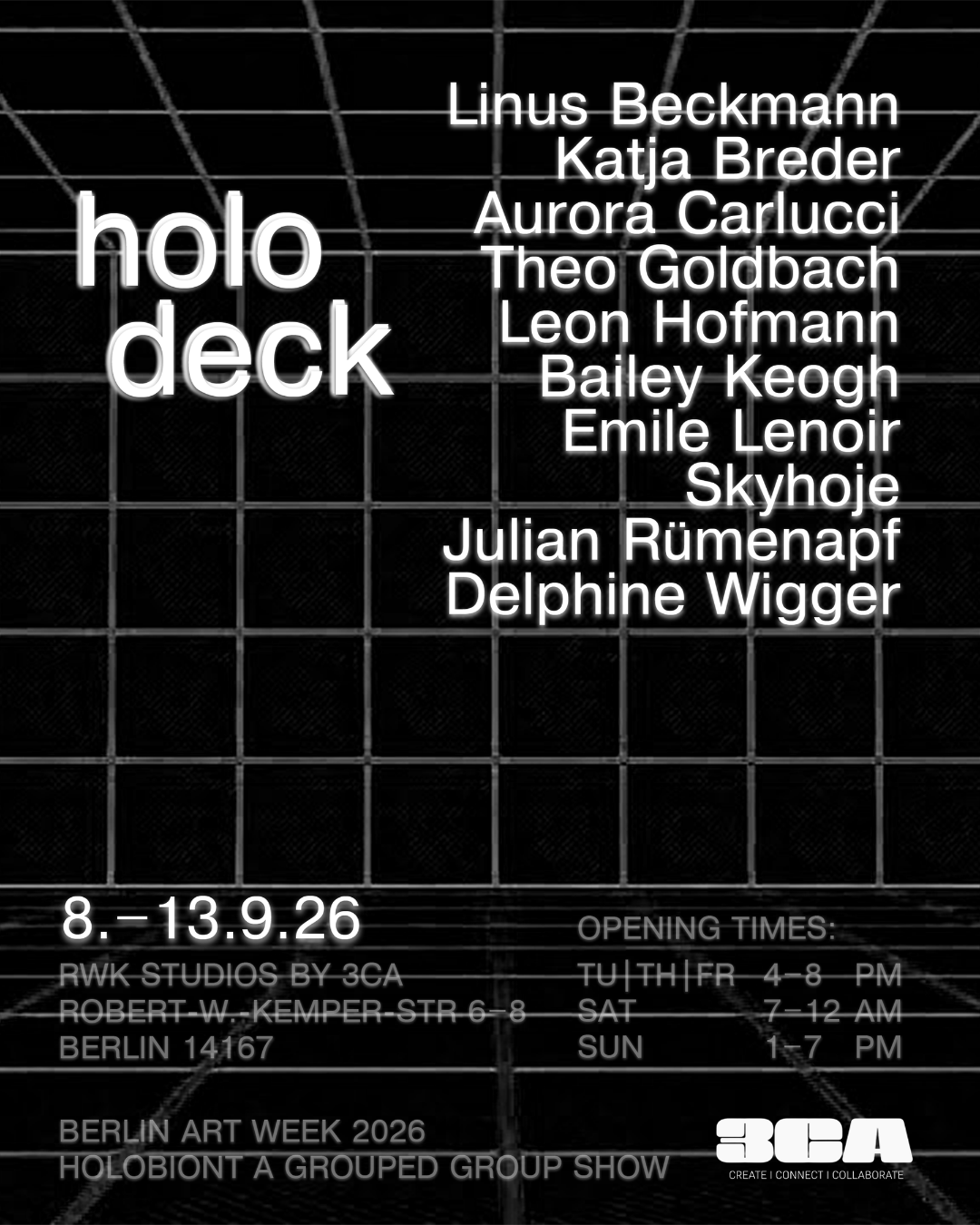
4. HOLODECK
Hall 3, shared, 400 m²
Curated by: Katja Breder, Delphine Wigger, Julian Rümenapf
Artists: Linus Beckmann, Katja Breder, Aurora Carlucci, Theo Goldbach, Leon Hofmann, Bailey Keogh, Emile Lenoir, Julian Rümenapf, Skyhoje, Delphine Wigger
Borrowing its title from the simulated environments of Star Trek, HOLODECK looks at the construction of realities through images, objects and sensory experience. Painting, installation, video and olfactory works transform existing elements into environments in which the imagined becomes physically perceptible.
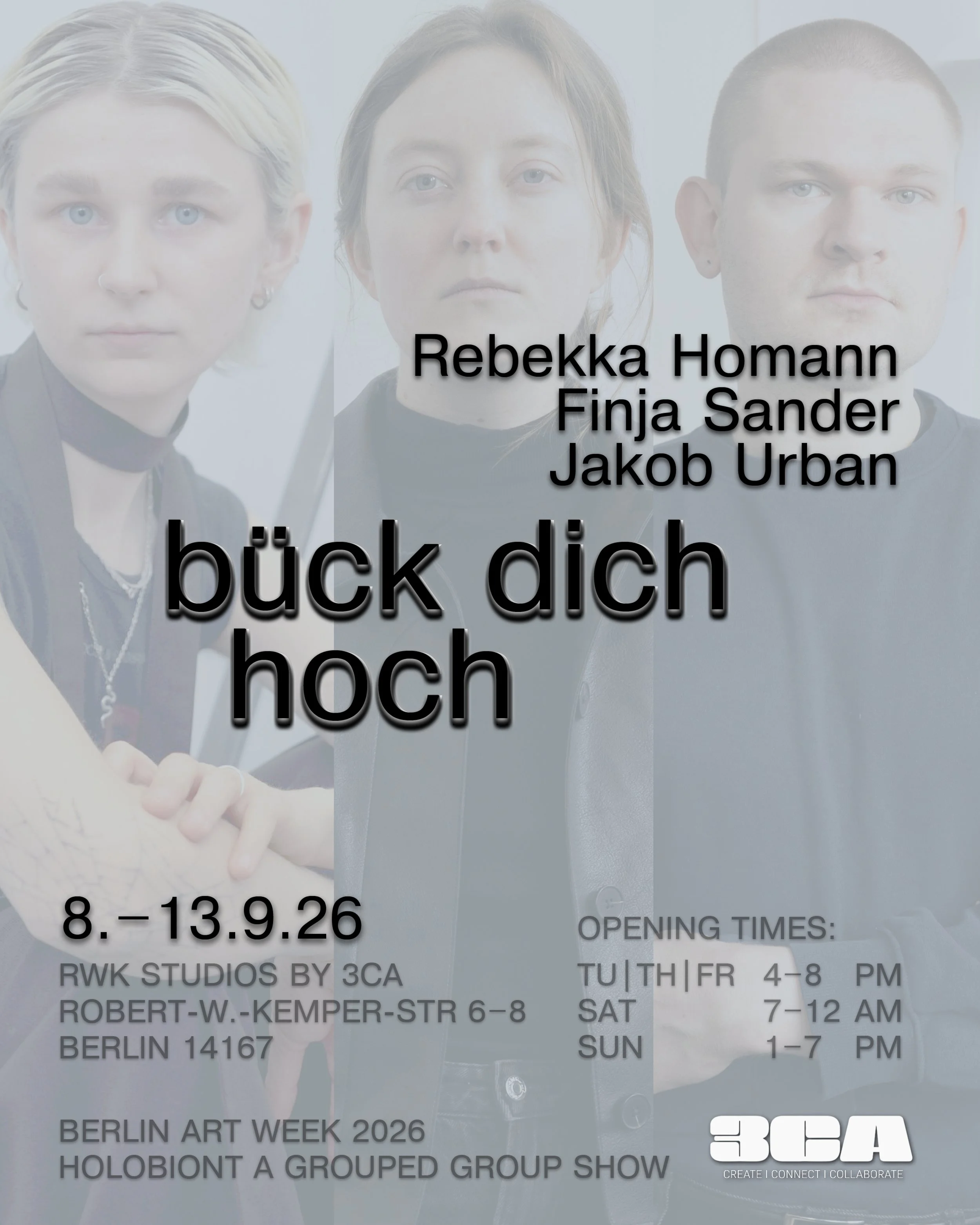
5. BÜCK DICH HOCH
Connecting spaces from Hall 3 across the site and yard
Self-organised by the participating artists
Artists: Finja Sander, Rebekka Homann, Jakob Urban
BÜCK DICH HOCH takes its title from the paradox of bending down in order to move upwards. The exhibition explores tensions between voluntary dedication and structural constraints. Across their practices, the artists examine how bodies, communities, and images are shaped by forces of power, labour, desire, and visibility. Moving through the transitional areas of the site, rather than occupying one room, the exhibition physically connects several spaces along the route.
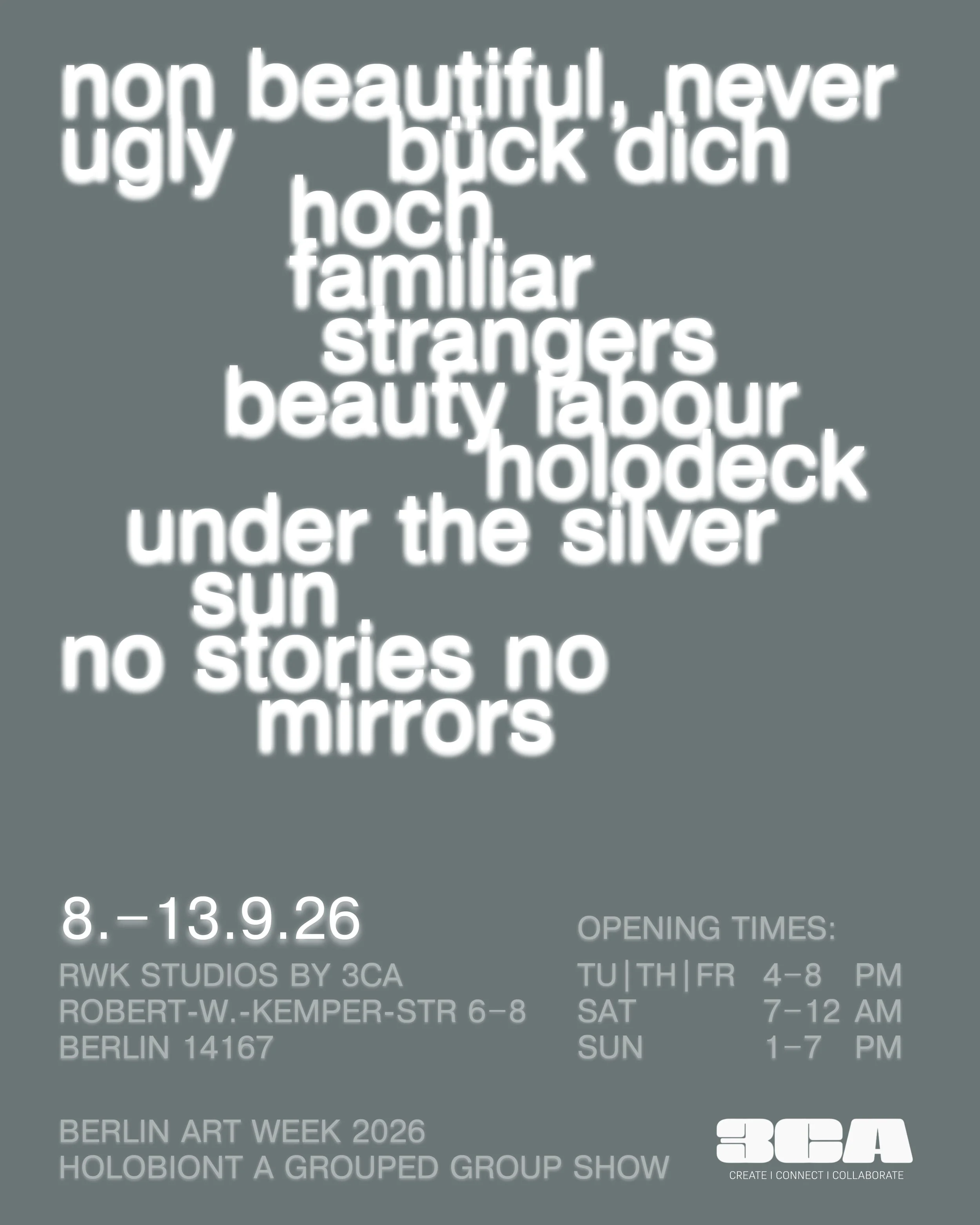
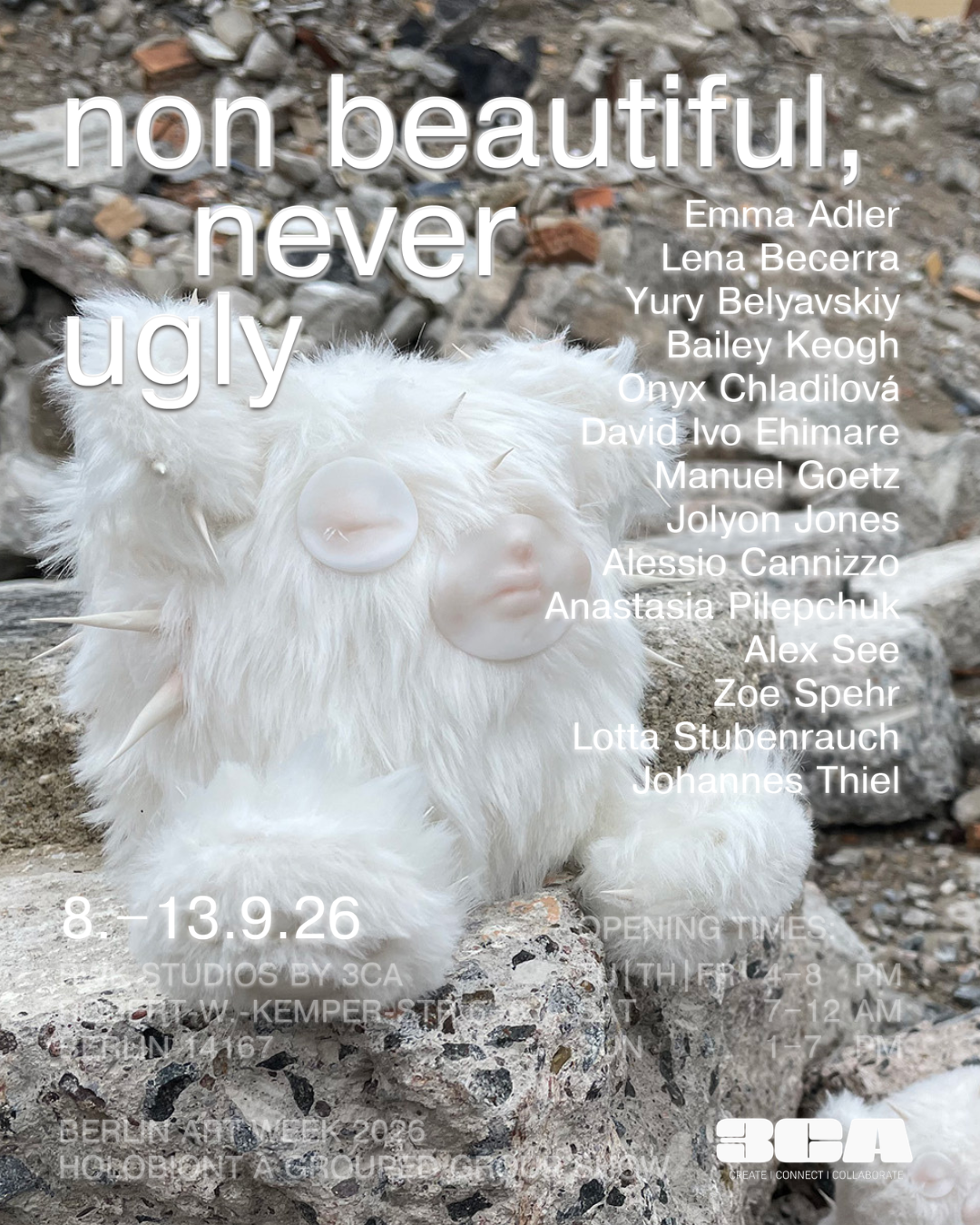
6. NON BEAUTIFUL, NEVER UGLY
Tile Hall, 200 m²
Self-organised by the participating artists
Artists: Emma Adler, Lena Becerra, Yury Belyavskiy, Alessio Cannizzo, Onyx Chladilová, David Ivo Ehimare, Manuel Goetz, Jolyon Jones, Bailey Keogh, Anastasia Pilepchuk, Alex See, Zoe Spehr, Lotta Stubenrauch, Johannes Theil
NON BEAUTIFUL, NEVER UGLY examines the unstable relationship between attraction and repulsion, tenderness and aggression, hardness and softness. Across sculpture, installation, photography and object-based practices, beauty and ugliness cease to function as opposites and become shifting conditions of perception.
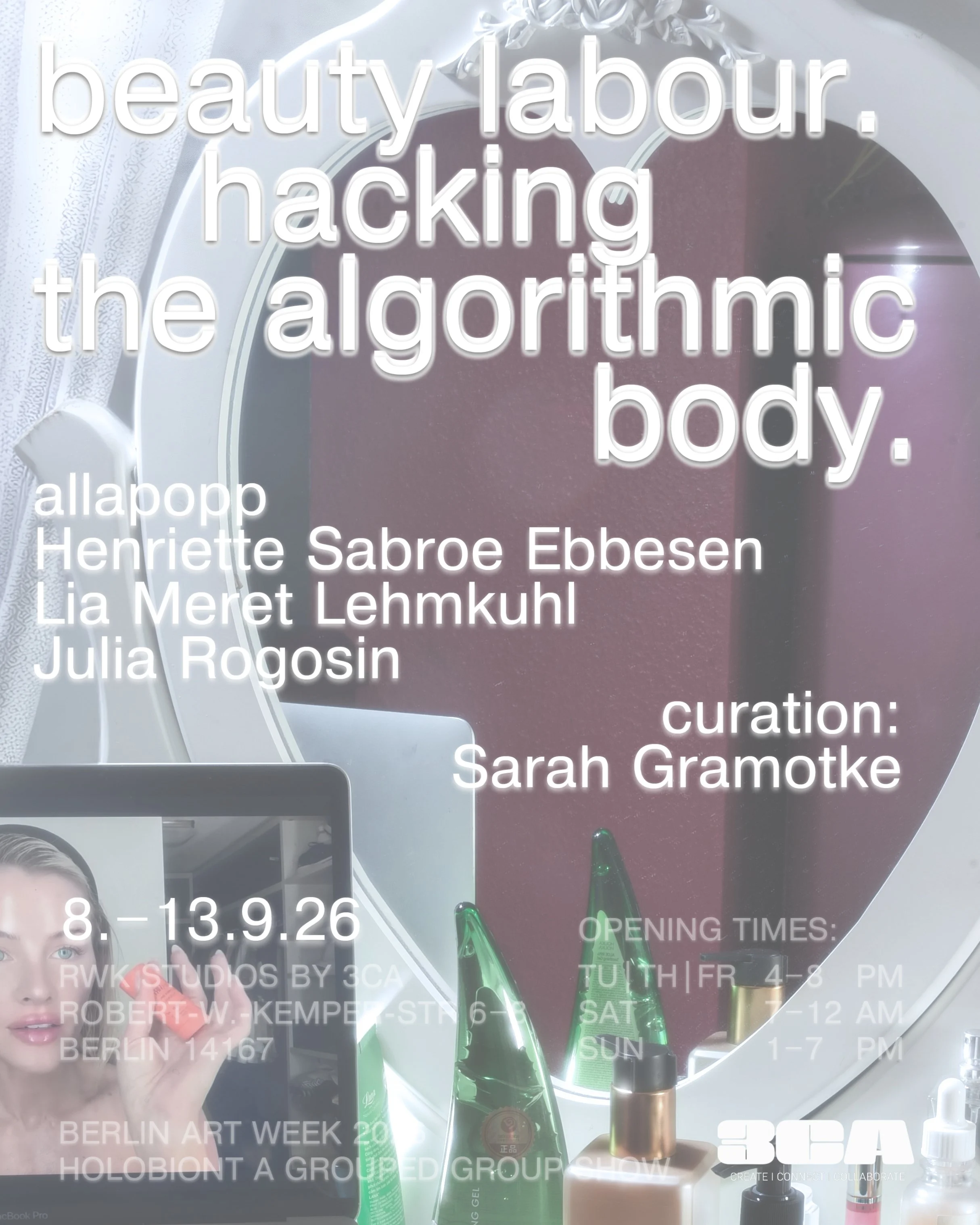
7. BEAUTY LABOUR. HACKING THE ALGORITHMIC BODY
Crane Hall, across the yard
Curated by: Sarah Gramotke
Artists: allapopp, Henriette Sabroe Ebbesen, Lia Meret Lehmkuhl, Julia Rogosin
BEAUTY LABOUR is an exercise in unlearning the algorithmic gaze. Taking the visual cultures of the manosphere and looksmaxxing communities as its point of departure, the exhibition explores where neoliberal self-optimisation meets algorithmically amplified body politics. Across video, installation, and photography, it examines how bodies become datafied selves, disciplined against AI-generated, transhumanist ideals, while even sleep and eating are recast as sites of production.
PROGRAMME
The public programme of HOLOBIONT runs from 8 to 13 September 2026 across the RWK Studios.
The overall programme framework is confirmed. Detailed speaker line-ups, individual performance titles and final programme additions will be announced shortly.
Registration for selected talks and guided tours opens on Monday, 24 August via 3caberlin.com/news, where the individual event pages and registration links will be available.
Tuesday, 8 September
Official Public Opening
16:00–20:00
The seven exhibitions open to the public.
At 18:30, HOLOBIONT hosts a public conversation bringing together artists, curators and invited voices around one of the recurring questions emerging across the seven exhibitions.
The conversation is followed by an audience Q&A.
The detailed topic and speaker line-up will be announced shortly. Registration opens on Monday via 3caberlin.com/news. Registered guests are invited to stay afterwards for a complimentary glass of wine and informal conversations across the exhibitions.
Wednesday, 9 September
Closed
Thursday, 10 September
Public Guided Tours
16:00–20:00
Three guided tours introduce visitors to all seven HOLOBIONT exhibitions as one connected programme.
Tours begin at:
16:30 / 17:30 / 18:30
Each tour lasts approximately 45–55 minutes and offers a concise introduction to the exhibitions, participating artists and curatorial positions.
Tours will be offered in German and English. Visitors are invited to return to individual exhibitions afterwards for longer visits and conversations.
Registration opens on Monday via 3caberlin.com/news.
Friday, 11 September
Exhibitions Open
16:00–20:00
The seven exhibitions remain open to all visitors throughout the afternoon.
Alongside the public opening hours, HOLOBIONT hosts a series of private exhibition visits for invited groups, cultural institutions, collectors’ circles and professional networks.
These hosted visits create an opportunity for more focused encounters with the exhibitions, participating artists and curators, followed by an aperitif and informal conversations.
The private hosted tours are invitation-based and take place alongside the regular public opening hours.
Saturday, 12 September
HOLOBIONT – Long Night of Performances
19:00–24:00
A full evening of live performances unfolds across the seven exhibitions and the wider site.
From 19:30 onwards, performances activate different halls, exhibitions and outdoor spaces, creating a route through HOLOBIONT over the course of the night.
The programme leads into an extended live sound / closing performance from 23:00–24:00.
Bar and exhibitions remain open throughout the evening.
The participating performers are drawn from across the HOLOBIONT exhibitions and invited artistic positions. Individual performances and artists will be introduced via @3caberlin in the lead-up to the event.
The full Long Night programme will be released as a programme highlight next week.
Sunday, 13 September
Open House / Tag der offenen Tür
13:00–19:00
HOLOBIONT closes with a relaxed Open House across the entire site.
The programme brings together all seven exhibitions, open studios, performances, informal artist conversations, readings, guided formats, food and drinks, coffee and cake, and a family programme for children.
Additional small-scale conversations, readings and performances will take place throughout the day.
Outside, Vice Club presents a curated line-up of classic cars as part of the Open House.
The day is conceived as an open invitation to spend time across the site, meet artists, visit studios and experience the exhibitions in a more informal setting.
Further programme details will be announced via 3caberlin.com/news.
PROGRAMME UPDATES & REGISTRATION
Detailed schedules, confirmed speakers, individual performance titles and registration links for selected programme formats will be released in the lead-up to the event.
From Monday, 24 August, all programme updates and individual event pages can be found via:
Where registration is required, the respective registration link will be available directly from the event page.
3CA KEY FACTS
Name: 3CA, Create, Connect, Collaborate × Art Location: RWK Studios, Robert-W.-Kempner-Straße 6-8, 14167 Berlin Site: approximately 16,000 m² Artists on site: around 60
Infrastructure: studios, halls, production spaces, photo studio, welding and wood workshop (RWK Werkstatt e.V.), areas for exhibitions and public formats
Formats: open studios, exhibitions, workshops, performances, talks, art education
Funding and exchange: FLINTA Shared Space, a residency programme granting artists a free workspace for three months, and RWK Werkstatt e.V. as a non-profit structure for workshops, art education, youth and educational work
Reference project: ART House Rummelsburg, Berlin-Lichtenberg. Cultural interim use of a vacant property over roughly eighteen months, with studios, exhibitions, performances and interdisciplinary events.
Team Franziska Röhrs, creative direction, artistic development, community and curatorial processes Nancy Schumacher, operations, finance, contracts and organisational structures Johannes Bube, site development, owner relations, partner network Jonas Kirsch, patron and co-founder
Founded by Franziska Röhrs, Johannes Bube and Jonas Kirsch. Run today by Franziska Röhrs, Johannes Bube and Nancy Schumacher.
3CA, ABOUT THE PROJECT
3CA began with a concrete observation. Many artists in Berlin lack affordable, reliable, usable working space. At the same time, industrial and commercial properties stand empty or underused. 3CA works in that gap with its own model of cultural interim use.
The question at the centre is how temporarily available space can be activated as functioning artistic infrastructure rather than played for a season. 3CA develops sites where studios, workshops, exhibition areas, production spaces, community formats and public programmes come together. What matters is not staging a place as an event location, but its actual usability as a working space for contemporary artistic production.
The approach is thought from the perspective of practice. What conditions do artists need in order to work, produce, document and develop, rather than only to exhibit? The RWK Studios therefore include large halls, welding and wood workshops, a photo studio and photographic documentation of works alongside the studios themselves, so that central production steps can happen on site.
Around sixty artists currently work on the 16,000 square metre site. 3CA is neither a conventional studio house nor a closed collective, but a production site with independent artistic positions, shared infrastructure and formats for exchange, visibility and professionalisation. Alongside the studios it runs open houses, exhibitions, workshops, performances, the FLINTA Shared Space residency and the non-profit RWK Werkstatt e.V.
3CA treats vacancy not as a transitional state but as a starting point for artistic production, structural collaboration and new forms of public life. Cultural places do not come into being through available floor space alone, but through responsibility, structure and a concrete understanding of how artistic work actually happens.
PARTICIPATING ARTISTS AND CURATORS
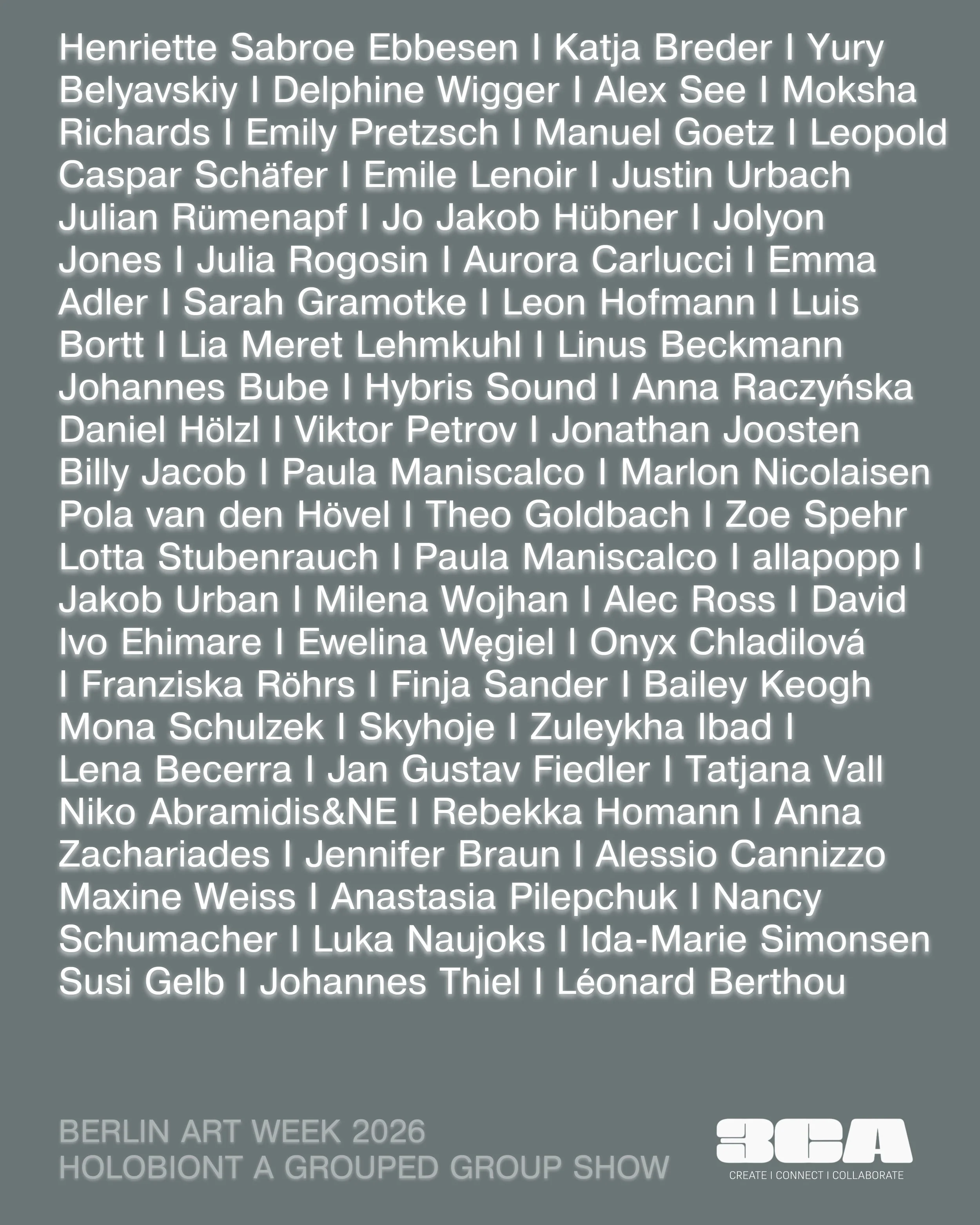
Niko Abramidis &NE, Emma Adler, allapopp, Lena Becerra, Linus Beckmann, Yury Belyavskiy, Léonard Berthou, Luis Bortt, Katja Breder, Alessio Cannizzo, Aurora Carlucci, Onyx Chladilová, Henriette Sabroe Ebbesen, David Ivo Ehimare, Susi Gelb, Manuel Goetz, Theo Goldbach, Sarah Gramotke, Leon Hofmann, Daniel Hölzl, Rebekka Homann, Jo Jakob Hübner, Zuleykha Ibad, Jonathan Joosten, Jolyon Jones, Bailey Keogh, Lia Meret Lehmkuhl, Emile Lenoir, Paula Maniscalco, Luka Naujoks, Marlon Nicolaisen, Viktor Petrov, Anastasia Pilepchuk, Emily Pretzsch, Anna Raczyńska, Moksha Richards, Julia Rogosin, Alec Ross, Julian Rümenapf, Finja Sander, Leopold Caspar Schäfer, Mona Schulzek, Alex See, Ida-Marie Simonsen, Skyhoje, Zoe Spehr, Lotta Stubenrauch, Johannes Thiel, Justin Urbach, Jakob Urban, Tatjana Vall, Ewelina Węgiel, Maxine Weiss, Delphine Wigger, Milena Wojhan, Anna Zachariades
55 artists and curators across the seven exhibitions, plus open studios across the site.